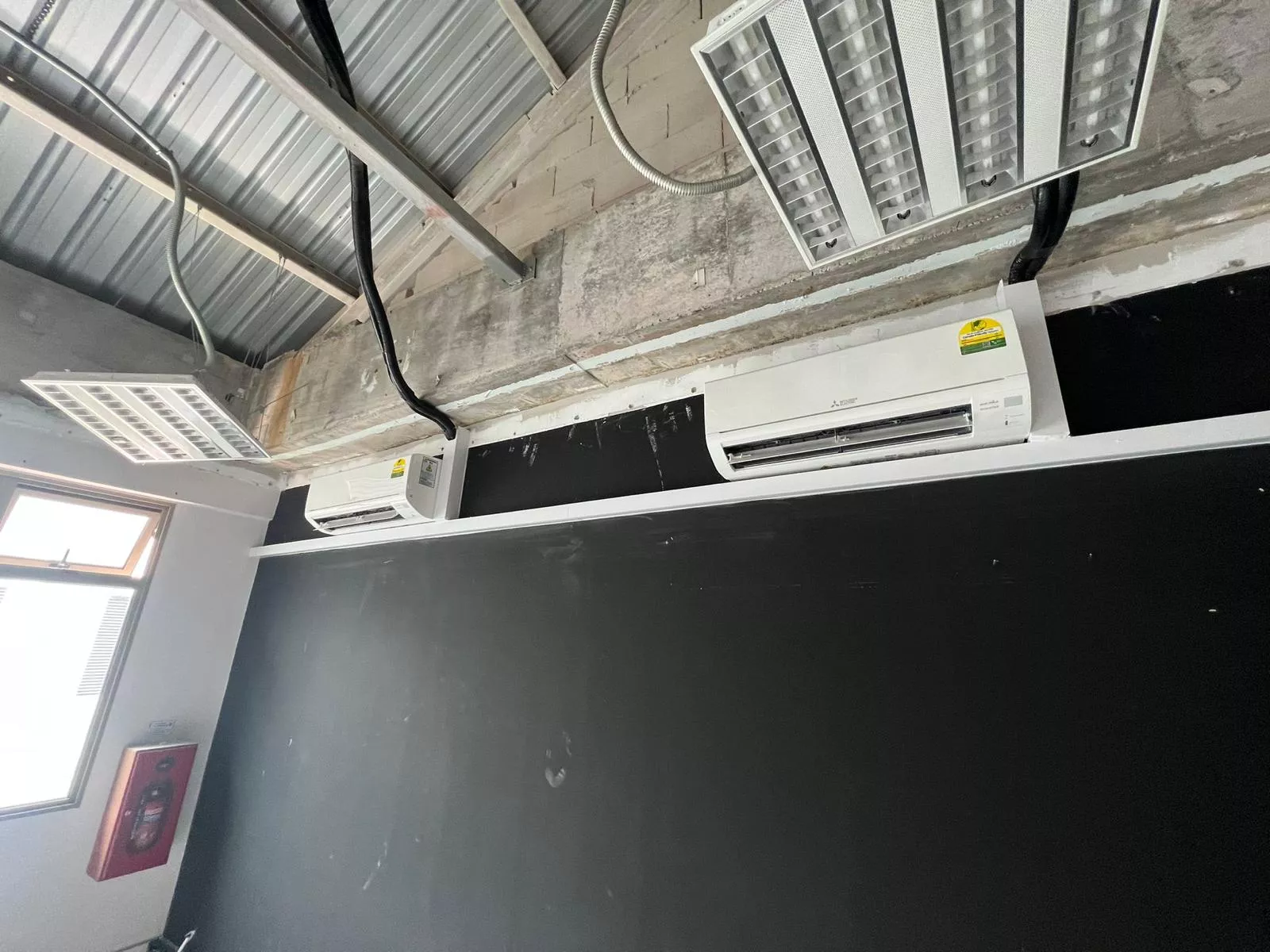
You press the remote and nothing happens. No beep, no louvre opening, no light. Or the light comes on, the flap opens, and then the unit sits there doing nothing. Before anyone mentions a board or a compressor, there are a handful of checks that take five minutes, cost nothing, and settle a surprising number of these calls on the spot.
The checks matter for a second reason. When they do not fix it, what you found tells the technician where to look — and the difference between "the whole system is dead" and "one bedroom unit ignores the remote" is the difference between two quite different jobs.
First, what exactly is not happening?
"Not turning on" covers five different situations. Work out which one you have before you touch anything, because each one points somewhere different.
- Completely dead. No beep, no lights, no movement, on every remote press.
- One unit dead, the others fine. On a System 2, 3 or 4, a single indoor unit will not respond while the rest of the flat cools normally.
- The display lights up but the unit ignores the remote. There is power, but it is not taking instructions.
- It starts, then stops, and a light blinks. The unit is switching itself off and reporting something.
- The fan blows but the air never gets cold. Strictly speaking it has turned on — the indoor unit is running, and it is the outdoor side that is not.
The five-minute checks
1. The remote
Look at the remote's own screen first. If it is faint, blank or flickering, change both batteries — with fresh ones, not ones taken out of another remote. If the screen looks normal, check three settings people change without meaning to: the mode (fan mode will run all day without cooling the room), an on-timer or off-timer that is set, and a key lock or child lock symbol on the display.
Then test whether the remote is actually sending anything. Open your phone's camera, point the end of the remote at the lens and press a button. Most phone cameras show the infrared light as a small flicker on the screen that you cannot see with your eye. If you see nothing, try the phone's front camera — some rear cameras filter it out. No flicker on either camera, with fresh batteries, means the remote is the problem, not the aircon.
2. The unit's own button
Most wall-mounted units have a small manual or emergency operation button, usually just under the front panel or on the side of the casing. Lift the front panel only as far as it opens by hand — no tools, nothing unscrewed — and press it once.
If the unit starts from its own button but not from the remote, you have narrowed it to the remote or the unit's receiver. If it does not start from its own button either, the problem is power or the unit itself, and the remote was never the issue.
3. The isolator
Every aircon should have an isolator — the local switch, usually near the indoor unit or at the service yard, that lets the system be made electrically dead without switching off the whole circuit. It gets knocked off during renovation, when furniture is moved, and after servicing. Check that it is on.
While you are there, look at it. Brown or black marks around the switch, a plate that has gone yellow or soft, or any smell of hot plastic means stop here: leave it off and read what to do when your aircon smells like burning before anything else.
4. The breaker
Go to the distribution board and look for the aircon's breaker. If it has tripped, you may reset it once. If it trips again straight away, or trips again when the aircon starts, leave it off. A breaker that keeps tripping is protecting you from a fault, and resetting it repeatedly sends current back through that fault each time.
If the aircon is running from an ordinary socket, an adaptor or an extension cord rather than a proper point, note that too. A new remote or a service will not fix a supply that was never right for the load. We set out why in the power point nobody quotes for.
5. Give it five minutes
After a power cut, a tripped breaker or the isolator being switched back on, many units do not start the outdoor side immediately. That short wait is there to protect the compressor. If the indoor unit is blowing air but not cooling in the first few minutes after power comes back, wait five minutes before deciding anything is wrong.
What the pattern usually points to
The whole system is dead
When every indoor unit on the same system stops at once, the cause is almost always something they share: the supply to the system, the isolator, the breaker, the outdoor unit, or the cabling that links the indoor units to it. A fault in one indoor unit does not normally take out the other three.
That matters for who does the work. Anything on the aircon side of the isolator is aircon work. New wiring from the distribution board, or a fault on the supply side, has to be carried out or supervised by an EMA-licensed electrical worker. A good aircon technician will tell you which side the fault is on rather than quietly running a cable.
One unit dead, the rest fine
The supply is working — the other units prove it — so the problem is local to that indoor unit: its control board, its receiver, or the cable connection that serves it. This is the case the remote test and the manual button are most useful for, because they separate "the unit is not hearing the remote" from "the unit is not getting power or cannot act on it".
Lights on, but it ignores the remote
If the remote passed the camera test and the manual button works, suspect the receiver on the indoor unit. If the manual button does not work either, the unit has power but the board is not acting on it. Both need the unit opened and tested.
Starts, stops, and blinks
A blinking light in a pattern is the unit's way of reporting a fault it has detected, and the codes are specific to the brand and often to the model. Do not keep switching it on and off to watch it happen again. Take a short video of the blinking — counting the blinks is enough — and photograph the nameplate on the indoor unit if you can reach it.
Fan runs, air never gets cold
The indoor unit is working and the outdoor unit is not doing its part. Go to where the outdoor unit is — as far as you can see safely, without leaning out over a ledge — and note whether its fan is turning and whether you can hear it running. A silent outdoor unit and a humming one that never gets going are different findings. Before anyone tells you the compressor has gone, read how to check that diagnosis before you pay — a failed capacitor can look very similar and costs a fraction as much.
When it happened is a clue too
- Straight after a power cut or a thunderstorm. Reset the breaker once if it tripped, give the unit its five minutes, and if it still does not respond, say so when you message — it is useful information for whoever checks the board.
- Straight after a service, a wash or any cleaning. Check the isolator first, and check the front panel and filters are fully back in place. If it was working before the visit and not after, raise it with whoever did the work before paying anyone else. That is what a workmanship warranty is for, and what a workmanship warranty actually covers explains what to ask.
- Straight after renovation works. Isolators get switched off, cables get pinched behind new carpentry, and sockets get moved. Tell the technician what was done and where.
- On a system still under warranty. Find the installation invoice and the model and serial numbers before anyone opens it, so the warranty question can be answered first.
What it costs to have it checked
These are the figures on our published price list, and they are final.
The visit: $45 for one unit. That covers the technician coming out and the 9-point pre-check, whose first point is a power and thermostat test — confirming the electrical supply, the board's response and the remote before anything is taken apart. If the fix needs more work and you go ahead, the $45 is part of the total rather than charged on top. If you decide not to proceed, the $45 covers the visit and the diagnosis, and nothing more.
Standard repairs (drainage and electrical): $80. On our repair page, "won't turn on" is listed against three usual causes: the capacitor, the PCB, or the remote signal. Which of those your unit has — and so what the fix costs — is confirmed at the pre-check, not guessed over the phone. PCB and compressor replacement are quoted on-site, after the pre-check has confirmed what actually failed, and you get that figure before any work starts. Repairs carry 90 days on workmanship, and parts carry the manufacturer's warranty.
If it stops at night. Standard hours are 9am to 9pm Monday to Saturday and 10am to 6pm on Sunday, with no weekend surcharge, and same-day slots are usually available during weekday business hours. An after-hours emergency call between 10pm and 7am carries a $50 surcharge. A unit that simply will not start — with no smell, no scorch marks and no breaker that keeps tripping — is not dangerous left off overnight; the surcharge is worth paying when someone in the home genuinely cannot get through the night without cooling, not because the diagnosis will be any different in the morning.
The short version
Check the remote's batteries and settings, test it with your phone camera, and try the unit's own button. Make sure the isolator is on, and reset a tripped breaker once — never repeatedly. Give it five minutes after any power interruption. If it still will not start, the pattern tells you where the fault is: everything dead points to what the units share, one unit dead points to that unit, and a fan with no cold air points to the outdoor side.
Aircon still will not turn on after the checks? WhatsApp us on 9107 2601 — tell us whether it is one unit or all of them and what the checks showed, and we will tell you what we need to look at and when we can come.